The Sticky Floor
Mourning, Resistance, and the Unfinished Crime Scene of History

There is always a time like this. That’s the first lie we must dismantle: the idea that this moment is exceptional, unprecedented, shocking. Militarized borders, police killings, detention camps, bodies erased by bureaucracy—has never been exceptional.
For some people, yes. For others—Black bodies, Indigenous, colonized bodies, surplus bodies, migrant bodies—A “time like this” is not an emergency. It is the default operating system of empire.
A time like the triangle trade? A time like the plantation? A time like Jim Crow, apartheid, the Holocaust, Indochina, Algeria, Congo, Palestine?
A time like redlining, crack epidemics, mass incarceration, drone strikes, border cages, Mediterranean graves?
So, when they ask, “How are we supposed to react when Africans / immigrants are pouring in from everywhere?” the question itself is already dishonest.Because the real question is older, simpler, and far more uncomfortable: How were Africans supposed to react when Europe poured into Africa?
With guns. With flags. With missionaries and mining companies. With ledgers, whips, borders drawn by strangers, and economies designed to extract rather than sustain. And when the formal empires fell, the companies stayed. The pipelines stayed. The contracts stayed. The looting stayed—rebranded as “development,” “partnership,” and “foreign investment.”
The anxiety surrounding migration in Europe and the United States rests on selective amnesia. Empires moved freely across the world for centuries; now the movement of people is treated as a transgression. The imbalance is not new. Only the direction has changed.
So, the real question is not moral. It is historical. A time like what—and for whom?
Arundhati Roy warned us: “The trouble is that once you see it, you can’t unsee it.” Many are seeing it now—because the machinery has begun to graze whiteness. And suddenly: urgency. Suddenly: outrage. Suddenly: This could happen to anyone.
Welcome to the party. You’re late. The floor is still sticky with blood.
For some of us, life has always been lived with one foot in mourning and the other in resistance. We learned to laugh under duress not because we are careless, but because despair is exactly what empire wants.
White Supremacy Is Not an Attitude — It Is a System
White supremacy is not about individual hatred. It is not about bad apples. It is not even primarily about skin tone. It is a structural system, engineered to rank human life, distribute violence downward, and call the result “order.”
White people were not born supremacist. They were recruited into supremacy. It means whiteness was created for white supremacy.
It is an ideology—portable, profitable, adaptable. That system eats Black and brown bodies first. Then all sort of migrants, the Indigenous people. Then queer and disabled bodies. And eventually—when it runs out of “others”—it turns inward and consumes its own custodians.
That’s why it is absurd—tragic, even—to watch people act shocked when white bodies are crushed by the same machine they once defended as “law and order.” The machine has no loyalty. Only momentum.
The Flag and the Funeral
There are moments when flying a national flag is not patriotism but Stockholm syndrome. For many, the flag has never represented safety, dignity, or belonging. It has represented conquest, erasure, extraction, and lies told with a straight face. So, forgive us if we refuse to lower our voices at the crime scene of history.
Some of us were born into mourning. We came screaming into a world that had already decided our disposability. Therefore, do not tell us when it is appropriate to speak the truth. Especially not when the truth is standing over yet another body.
State violence is not an accident of history; it is the method. Colonialism did not fail. It worked and still work. Fascism is not a deviation. It is imperialism speaking honestly.
This is why the West suddenly “wakes up” when state violence grazes whiteness.
So, when governments propose to “expose” the ethnicity or religion of criminals—this is not about justice. It is about laundering racism through bureaucracy. That’s how power works: data for discipline, silence for itself.
We are not witnessing an exception, but a continuum tragoediae.
In the United States, people disappear into ICE detention, police cells, prisons, and unmarked graves with barely a headline. Names vanish. Stories are erased. There is no footage, and therefore no outrage. When violence remains contained within racialized bodies, it is rendered ordinary.
But when Renée Good and Alex Pretti—white, middle-class—are publicly executed, cameras turn on, conscience stirs, and the nation trembles. This does not make their deaths less tragic. It makes the system more visible.
What makes Alex Pretti’s killing unbearable is not only the violence, but his response to it. Blinded by chemical spray, lungs burning, disoriented and staggering, his body did not collapse inward. It reached outward—not to save himself, but to shield a woman who had been knocked to the ground. Under state violence, his instinct was care. Protection. Solidarity.
The state did not merely kill a protester. It killed a man in the act of compassion. That is the obscenity.
Europe often prefers to locate such brutality safely in history books, or to assign it to other countries. Norway, in particular, sustains a powerful myth of moral exceptionalism. But Norway has names too.
The proliferation of far-right ideology is not an anomaly. It is the fatal detonation of an ecosystem that treats white supremacist rhetoric as “extreme” only after it explodes. The Utøya massacre, which took 77 young lives, was the culmination of an ideology that had long been tolerated—and at times, quietly protected—by parts of the political and media establishment. Yet today, the victims’ names are scarcely remembered. What endures in public memory is the perpetrator: his image, his manifesto, the very ideology that carried out the violence.
This imbalance is not incidental. It is a pattern: the perpetrator is immortalized, the victims fade, and the ideology is debated only after it has already proven lethal.
Eugene Obiora died in police custody in Trondheim in 2006, restrained until his body failed. His death was ruled lawful. His humanity, apparently, was negotiable.
Tamima Nibras Juhar, a young girl, died after prolonged exposure to state neglect and institutional violence—her life discussed and dissected until responsibility dissolved into procedure.
Norway has other names as well. Benjamin Hermansen, a fifteen-year-old boy, was murdered by neo-Nazis in Oslo in 2001, in an attack explicitly motivated by racist ideology. Ali Farah, a Norwegian citizen of Somali background, was left without proper medical care after a violent assault in 2007, when emergency responders failed to treat him—an episode that exposed how racism can operate not only through force, but through denial of care. Alongside these are singular cases: Roma communities subjected to systematic suspicion, surveillance, and exclusion, where harm accrues not through one dramatic event, but through policy, practice, and repetition. Some violence is spectacular, others administrative.
And still, each time Norway says aldri mer—never again—the public debate drifts back to suspicion, control, punishment, and the familiar refrain: minorities as a problem to be “handled.”
The same hierarchy that decides whose deaths are tolerable also governs whose movement is framed as a threat and whose displacement is treated as a nuisance rather than a consequence.
Borders Are the New Battlefields
In the U.S., ICE operates with the logic of slave-catchers: unaccountable, armed, roaming neighborhoods, deciding who belongs and who doesn’t. Door to door. Brown body to brown body.
In Europe, Frontex patrols the Mediterranean as a floating graveyard. In Norway, the violence is quieter—paperwork, denial, silence—but no less real.
This is not about crime. This is not about security. This is about finishing old genocides while managing new ones. Empire does not stop killing. It just changes tools.
Solidarity Is Not a Panic Reaction
Here is the uncomfortable truth: many people are not mobilized by justice. They are mobilized by proximity. When violence finally touches white bodies, suddenly it is urgent. Suddenly it is intolerable. Suddenly it is “authoritarianism.”
And that is why solidarity cannot be transactional. You do not summon it only when the fire reaches your street. You do not ask communities who have been used as human shields for centuries to once again absorb the blow—especially when those same communities were abandoned at the ballot box, in the courtroom, at the border.
Solidarity is not asking others to save you while you vote against them.
Solidarity is not a hashtag discovered at gunpoint. Solidarity is not leadership seized at the moment it becomes fashionable.
Solidarity is long memory. Solidarity is showing up before it is personal.
Solidarity is listening to those who have been screaming while you were comfortable.
And yes—this reckoning must include white people naming white supremacy as their problem to dismantle, not a burden outsourced to its victims.
Against Despair, Toward Dignity
Yes, Black bodies have been cast as eternal victims—but never as passive ones. We have resisted in every language available: revolt, culture, sabotage, laughter, care, refusal and resilience.
To live fully under siege is not betrayal. It is defiance. So no, you do not get to police how oppressed people cope. No, you do not get to dictate the tone of survival. No, you do not get to rewrite history because the blade finally touched your skin.
You are welcome to join the struggle. Truly. We need numbers, courage, imagination. But do not arrive pretending this is new. Do not center your awakening as the beginning of time. Do not confuse fear with virtue.
This has always been a time like this. The question is not why now? The question is: what will you do when the shock fades—but the system remains?
Because it will. Unless we dismantle it. Together.
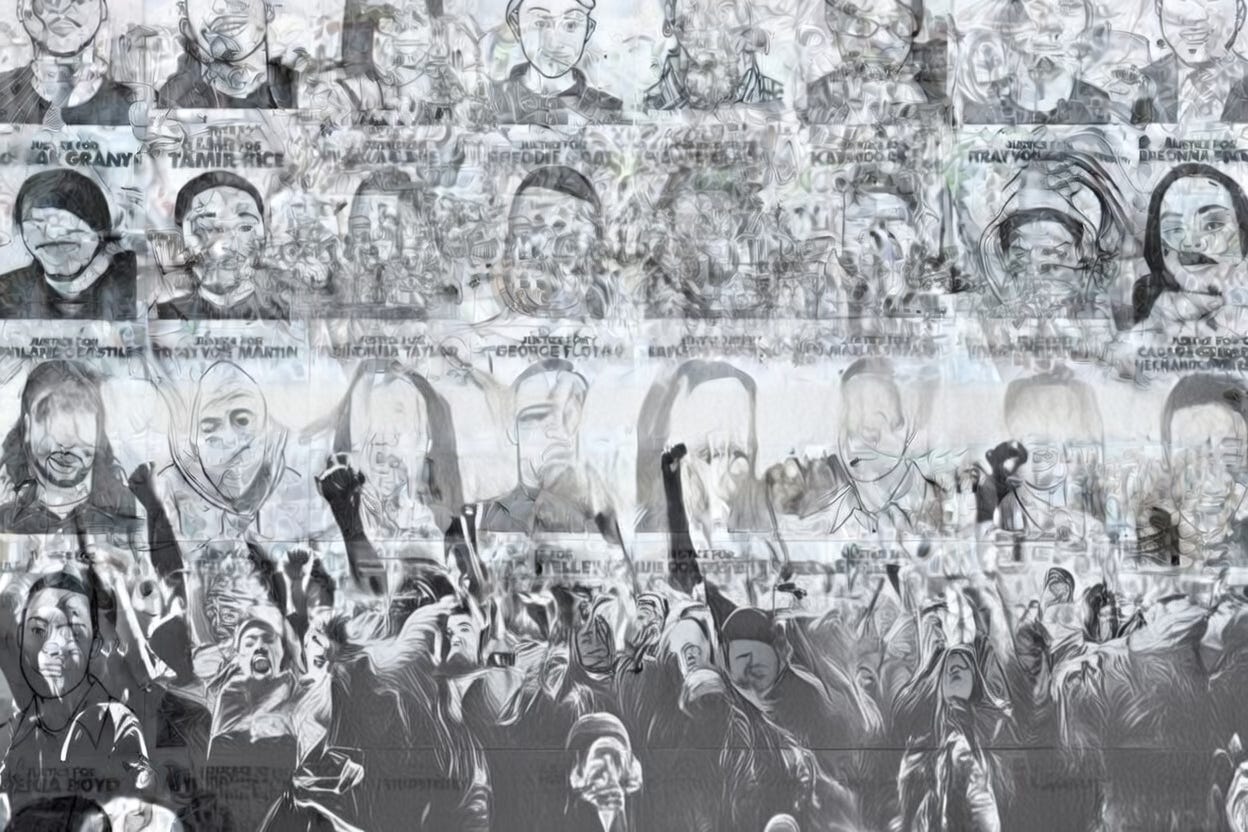
Don’t forget the incipient rage in the hours leading up to the assassin’s capture directed at Norway’s Muslim population, in exultant anticipation of their imminent lynching for belonging to the assumed perpetrator’s caste, - and the limp grovels of disappointment when the murderer turned out to be a white supremacist, -one of our own; one of us