
The Resemblance Test: How Remigration Turns Citizenship into a Beauty Pageant

Europe has an impressive talent for turning ordinary citizens into a civilizational crisis before lunch. A woman wears a headscarf: emergency panel discussion. A footballer fasts during Ramadan: national values are apparently trembling. A family asks for halal food at school: somebody reaches for the Constitution, a columnist dusts off a typewriter from 1987, and a minister promises “a national conversation.” It is almost touching. Countries that survived empire, war, oil crises, Eurovision voting and the invention of the comment section suddenly become fragile because Karim wants a prayer room at work.
Now Norway has added a new word to the collection: remigration. It sounds clean. Almost hygienic. Like a municipal recycling scheme, or a particularly stern wellness program. It is also doing an enormous amount of work. Because when people say “remigration,” they may claim to mean the voluntary return of people without legal residence, the expulsion of foreign nationals convicted of serious crimes, or the enforcement of immigration law.
Fine. Norway already has laws for that. People whose applications are finally rejected have a duty to leave. Those who remain without legal residence can be returned by the police. Foreign nationals convicted of crimes may be expelled. Norway has assisted voluntary-return programs. The state does not require a new imported ideology to enforce legislation it already possesses. So why the conferences? Why the slogans? Why the ideological tourism around a word that, according to its most enthusiastic European promoters, is not merely about immigration status but about “demographic composition,” “ethnocultural continuity,” and the restoration of a country imagined as purer than any country has ever actually been? That is where the clean shirt begins to show stains.
Norway Does Not Need a New Word for Existing Law
In the recent public exchange around remigration, the defense has been familiar: critics should debate the policy rather than invoke fascism; remigration supposedly concerns legal, voluntary and orderly return. But that is not the whole political package.
If remigration means that people without legal residence must leave, then Norway already does it. If it means that non-citizens convicted of serious crimes can be expelled, Norway already does it. If it means that applications are assessed and refusals have consequences, Norway already does it. No Martin Sellner is needed for that, No infamous, former ICE commander Gregory Bovino is needed for that. No international conference is needed. No imported movement with a taste for demographic panic, identitarian mythology and social-media provocations is needed.
The immigration authorities, the police, the Norwagian Directorate of Immigration (UDI) and The Norwegian Immigration Appeals Board (UNE) have been handling these matters for years, with laws, procedures, appeals and — crucially — limits. The very fact that “remigration” needs a movement, a summit and a political brand suggests that it is meant to be something more. And when the rhetoric moves from people without legal status to vague references to “the population,” “the strangers,” “incompatible cultures,” “demographic replacement,” or men, women and children as a single collective problem, we should stop pretending that this is simply a discussion about administrative return. It is a discussion about who gets to remain part of the national story. That is not immigration policy. That is identity politics with handcuffs in its pocket.
The Norwegian Version Comes with Indoor Voices
Norway rarely does its moral panics the American way. We do not always scream. We issue carefully worded concerns. We raise an eyebrow at a seminar. We produce a spreadsheet. We ask whether someone is “properly integrated,” preferably in a tone so moderate that the question itself appears too sensible to challenge. Norwegian prejudice often comes with good lighting and coffee.
That does not make it harmless. A person can be told they belong, but only conditionally. You are Norwegian, but not so Norwegian that people forget your grandparents came from elsewhere. You may work, pay tax, speak the language and vote, but perhaps do not become too visible. You may support the football team, but do not introduce complicated subjects such as racism, Palestine, discrimination, foreign policy or religious freedom into the conversation. You may be part of “us,” but please keep the “us” looking familiar.
This is the emotional logic behind remigration rhetoric: belonging is not treated as citizenship, residence, contribution or human equality. It is treated as resemblance. The more you resemble a nostalgic postcard, the safer you are. The less you resemble it, the more likely someone will discover that your presence has become a “debate.”
The United States: A Warning, Not a Manual
The United States has shown what happens when border policy becomes political performance. Immigration enforcement is not merely discussed as law; it is staged as spectacle. Raids become content. Deportation becomes branding. Cruelty becomes proof of seriousness. A family is no longer a family but a “case.” A neighbour is no longer a neighbour but a “threat.” The human being disappears behind the slogan.
Europe watches this with the strange fascination of someone looking at a house fire and saying: “Interesting interior design.” But American-style politics does not stay in America. It travels. It arrives in European language, European parties and European social-media feeds. It arrives with new slogans, new conference guests and old fantasies: that a country can cure every failure in public services, housing, wages, trust and democracy by removing the people politicians have selected as symbols of decline.
This is attractive because it is simple. It is also nonsense. A state that cannot build housing does not become competent by blaming a Somali-Norwegian family. A government that cannot fix overloaded schools does not become visionary by turning Muslim children into demographic statistics. A country that has failed on jobs, inequality, mental health or regional development does not become strong because it has found a new way to make brown people explain why they exist. That is not policy. That is scapegoating with a logo.
Europe Made the Family It Now Pretends Not to Know
Europe has spent centuries moving people around the world through conquest, slavery, colonial extraction, labour recruitment, war, borders and market power. Then Europe acts startled when the descendants of those histories appear in European cities. It is the oldest family drama in the house.
Europe has children everywhere, but prefers some children to sit at the table only as guests. The adopted children are easier: they are expected to say thank you. The children produced by empire are more inconvenient. They ask questions. They know the family history. They notice that the inheritance has not been shared equally. They refuse to apologize for having been born into a story Europe itself created.
France knows this drama particularly well. Britain knows it. The Netherlands knows it. Belgium knows it. Italy knows it. Norway, with its own global economic connections and growing diversity, is not outside history simply because the national costume is beautiful and the welfare state is well organized. The question is not whether every form of migration is uncomplicated. It is not. The question is whether democratic states will manage migration through law, rights, fairness and social investment — or through the fantasy that nations are fragile porcelain ornaments threatened by ordinary people living ordinary lives.
The World Cup Has Been Explaining This for Years
The World Cup is usually sold as a sporting event. It is also a map of history wearing football boots. Look at the squads and you can trace empires, trade routes, slavery, labour migration, war, displacement, recruitment and opportunity.
The point is not that players with African, Asian, Caribbean or Middle Eastern roots are somehow less French, English, Dutch, German, Norwegian or Italian. The point is the opposite. They are evidence of history. They are evidence that national stories have never been as tidy as nationalist movements pretend. They reveal where power travelled, who was moved, who was excluded, who built, who served, who survived and who arrived later only because earlier generations were forced to move first.
The remigration fantasy wants to look at that history and say: reverse it. Return people to an imagined origin. Restore an imagined purity. Undo the modern nation by treating human beings as administrative debris. But history does not work like a spreadsheet. People are not misplaced furniture. A Norwegian citizen is not a temporary visitor because someone dislikes their name, religion, hair, food or grandparents. And a democracy cannot survive by making belonging dependent on how comfortable the majority feels at any given moment.
The solution should not be naïve immigration policy indeed politic, It does not need to pretend that crime, failed integration, extremist violence or strained services do not exist.
A mature democracy can enforce immigration law. It can return people who have no legal right to remain, with due process and dignity. It can expel non-citizens who commit serious crimes, subject to law and proportionality. It can set clear expectations for language learning, participation and respect for democratic rules. But it must draw a bright line between lawful immigration policy and ethnic sorting.
That line matters. It is the line between governing and persecuting. It is the line between citizenship and ancestry. It is the line between a state that protects rights and a state that decides some citizens must spend their lives proving they belong.
The practical work is less glamorous than a remigration summit, which is why it receives less applause online. Invest in schools, jobs and housing. Fight discrimination in recruitment and rental markets. Fund local youth work, not only police responses after things have already collapsed. Protect synagogues, mosques, churches, Pride venues and community centres. Teach history honestly: colonialism, racism, migration, antisemitism, anti-Muslim hatred, Racism, Sámi oppression and Norway’s place in a larger world. Take hate crime seriously before it becomes a memorial speech. And stop treating entire communities as a security problem because a few politicians need someone to blame for everything they cannot fix.
Freedom for Some, Borders for the Rest
There is no moral reason why Europeans should be able to move through the world as though it were an extended holiday resort, while the citizens of the countries they visit are expected to remain politely behind the glass.
Africa cannot be Europe’s exotic zoo: a vast continent where Europeans may arrive freely to invest, extract, photograph sunsets, attend conferences about “development,” and occasionally discover spirituality in a village for three weeks — while Africans are expected to stay where they are, grateful for the occasional visa appointment and the privilege of being treated as a security concern at an airport.
Europeans who move abroad are usually called expatriates. It sounds elegant. It suggests wine, tax advice and a LinkedIn profile with a photo taken near a swimming pool.
A Canadian who settles in France is often an expatriate. A German who moves to Namibia is an expatriate. But let a Senegalese millionaire arrive in Italy, and suddenly he is an immigrant — a word increasingly used not as a legal description, but as a polite alarm bell for the presence of non-white people.
That is the trick: “immigrant” has become a pejorative category reserved mainly for those who do not look European enough, even when they are educated, wealthy, lawful, multilingual or more economically useful than half the people complaining about them online.
And this is where the question of African independence becomes unavoidable. What does administrative independence mean without economic independence? What does sovereignty mean when a country is formally free, but its economic future is still negotiated elsewhere, its markets shaped elsewhere, its resources priced elsewhere and its young people told that dreaming beyond its borders is somehow a moral failure?
What does it mean to be independent if you cannot imagine a future in your own country because the conditions for building one are constantly weakened by unequal global power?
The Better Question
The question is not whether Muslims, migrants or people with foreign roots are compatible with Norway or western values. They are already here. They are already Norwegian or European. They are already teaching children, driving buses, running companies, working night shifts, writing books, caring for patients, paying taxes, raising families and complaining about the price of brown cheese.
The question is whether Norway is compatible with its own principles. Can equality survive when it is selective? Can citizenship mean more than paperwork? Can a person be Norwegian without being required to look like a memory? Can politicians discuss immigration without smuggling ethnic panic into the language of law? And can we recognize that “remigration” is not neutral simply because it is pronounced calmly?
Europe’s financial power allows it to set the terms of the relationship. It influences trade rules, access to markets, investment, debt and tariffs. African states are often pressured to lower customs duties and open markets further, even when those revenues are desperately needed for schools, hospitals, infrastructure and local industry. Europe calls it partnership. Africa is often left holding the invoice.
Then, after centuries of extraction, unequal trade and economic control, Europe looks surprised when people move. It is rather like setting fire to the kitchen, taking the food, selling the plates, and then complaining that people have entered the dining room.
Migration is not only a question of borders. It is also a question of power: who gets to travel, who gets to choose, who gets to leave, who gets to return, and who is told that their entire life must fit inside an economic arrangement designed somewhere else.
A serious conversation about migration cannot begin with deportation fantasies and end with moral panic. It must also ask why so many people are denied the economic freedom to remain where they were born — and why the countries that benefit most from global inequality are often the loudest when its consequences arrive at their own borders.
Europe does not need fewer people. It needs fewer politicians using identity as a smoke machine to hide their lack of answers. Because the real threat to democratic life is not a woman in a headscarf, a Haitian teenager in a classroom, or a family asking for a place at the table. It is the old habit of deciding that some people must constantly prove they belong, while others are allowed to call their prejudice patriotism.
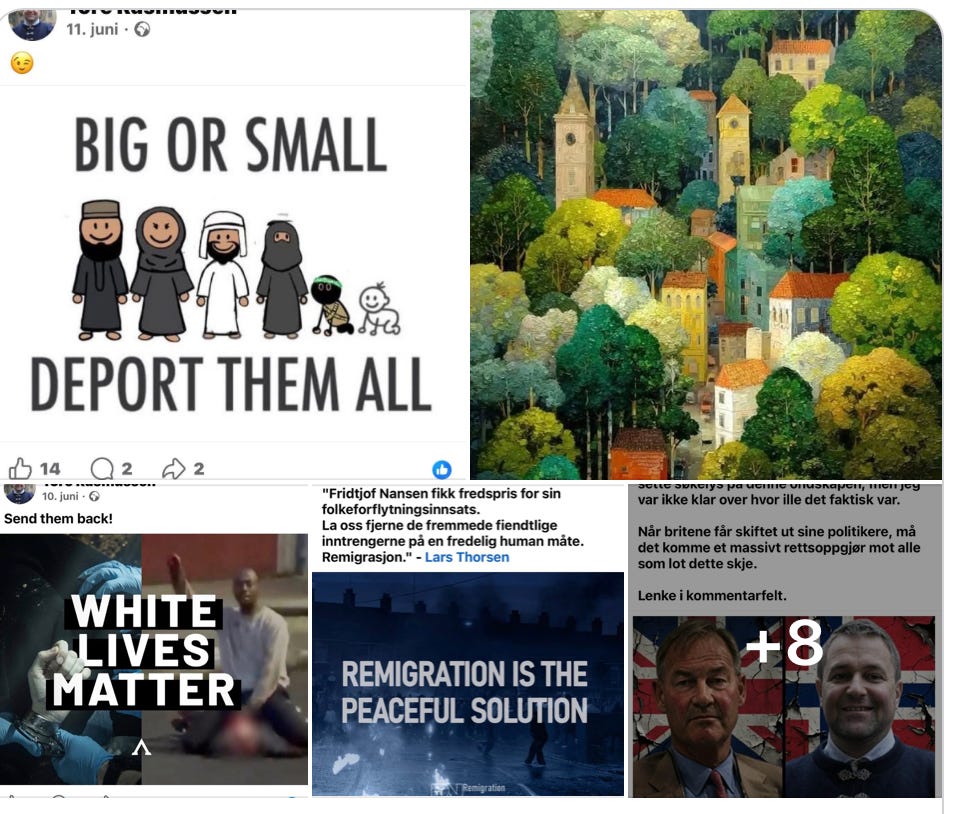
If you look closely the oligarchy in Norway has been carefully cultivating ties with the nazis in suits and ties across the ocean, to learn how to warp minds and subvert democracy, using "the other" as a scapegoat, and the social media as the channel. Already in 2019 the biggest norwegian media conference invited Steve Bannon to Norway, for him to teach them lessons of his "success" in the US:
https://www.nrk.no/kultur/steve-bannon_-_-jeg-tror-ikke-mainstream-media-er-interessert-i-a-bli-bedre-1.14544001
And later on it was exposed just how close this supposed "protest politician" was linked to the sordid oligarchy:
https://www.nationen.no/bannon-kom-rett-fra-epsteins-oy-til-mediedager-i-bergen/s/5-148-859430
https://www.bt.no/kultur/i/XM6k6o/jeffrey-epstein-ville-hjelpe-med-bergens-reise
So are the Norwegian oligarchy that own the media there, cutting ties with Bannon? No they are inviting him back to teach more:
https://nordiskemediedager.no/en/speakers/steve-bannon
For sure, they are planning to only whip up more xenophobia in NOrway. And of course, they need to - whp else to take the blame when they are determined to divert the money that should be spend on taking care of their people.....towards enriching nazis in Ukraine and the reactionary oligarchy that owns the weapons industry in the states.
https://www.regjeringen.no/no/aktuelt/langsiktig-stotte-til-ukraina-er-avgjorende/id3150045/
Teach history honestly.... yes!